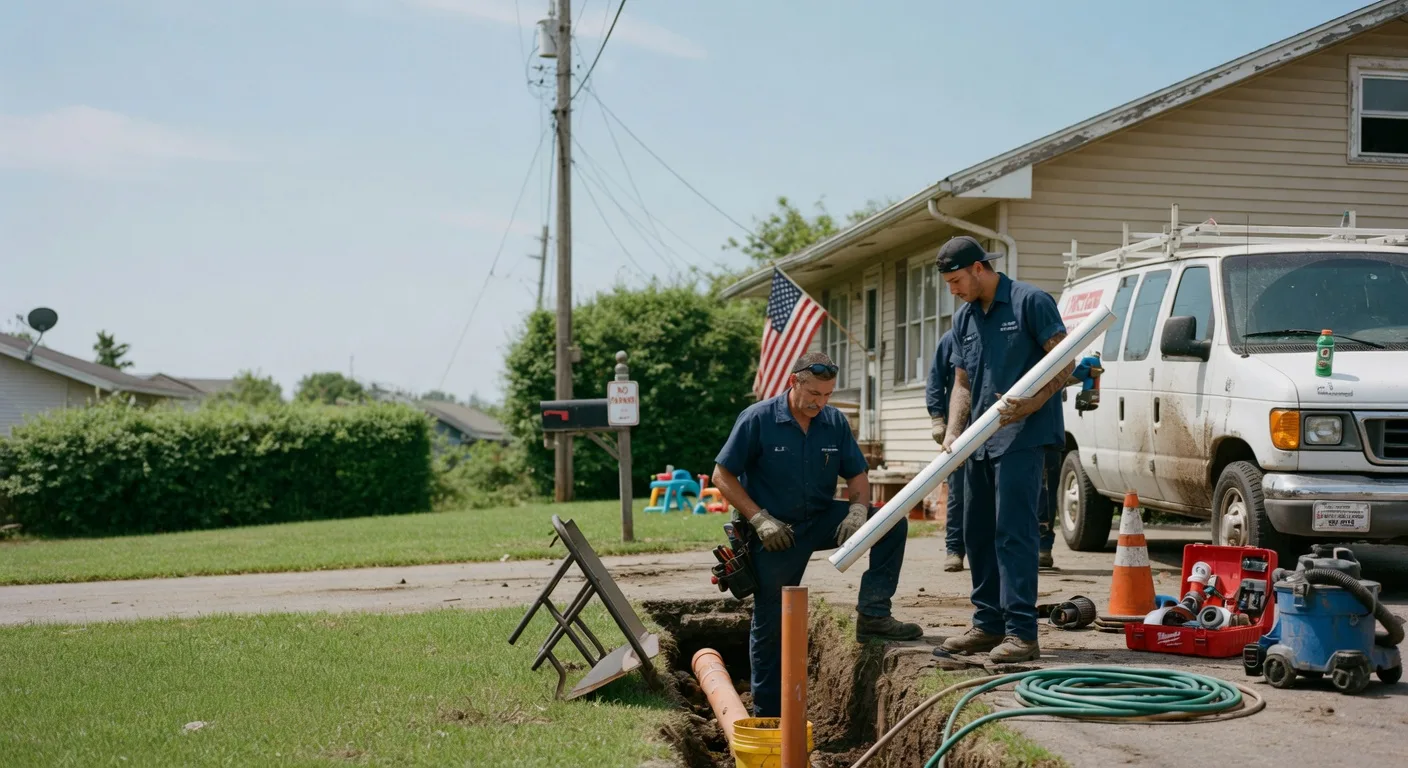
What does it mean if the cable machine stops at the same distance every time?
The cable stops dead at the same spot every time, and the plumber says it feels like a wall. That tells you the problem is fixed in one place. It is not a soft blockage that moves.
Common causes are tree roots that have grown in at a clay pipe joint, a section that has dropped or cracked, or a bellied line where the pipe sags and holds water. It can also be a bad coupling where one pipe no longer lines up with the next. A cable can punch through roots or grease, but it cannot get past a pipe that has shifted or broken.
Note the distance the cable went in. That number tells the next plumber where to look, and whether the fault is inside the house or out in the yard.
Safe homeowner check: if only one fixture is slow, go easy on water and note which drain it is. Stop running water and call now if several drains back up, if water comes up in a tub or floor drain, or if there is a sewage smell indoors.
A camera inspection is the right next step, because it shows what the cable hit. Roots or heavy grease may clear with hydro jetting. A broken or bellied pipe is a repair, and the cost depends on access, how much has to be dug or opened, the materials, and any permit required. Expert Plumbers Co is a referral service. Call (380) 262-9173 and we will connect you with a plumber in Collins, IA for Drain Cleaning.
Mark the spot where the stoppage sits if the cleanout or access point makes that possible, and tell the plumber whether the line runs under a slab, a driveway or a lawn. That decides how the repair is approached and how much has to be opened up. In older homes, the stoppage is often a clay joint that has been invaded by roots or has slipped, and the fix may be a spot repair on one section instead of replacing the whole run. In newer homes a stop at the same distance is more often a poorly set joint or a fitting that was installed out of line. After the camera has found the fault, ask for the footage or a few stills. They show the pipe material, the condition on either side of the problem and whether other weak points are coming. Until the repair is done, expect the line to clog again, so keep water use low and avoid putting anything but waste and paper into it.
We had roots cut out of our sewer line a year ago and now it is backing up again. What actually stops them coming back?
Cutting does not stop roots. It clears the pipe so water can pass, but the roots are still alive outside it and they grow back through the same opening. A year is a fairly typical time for a line to fill up again, and sometimes it is faster.
Roots get in where the pipe is not sealed: a joint that has shifted, a hairline crack, a broken section. Tree roots follow moisture, and a sewer pipe leaks a little water and vapor, which draws them in. As long as the entry point is open, regrowth is only a matter of time.
What actually removes the cause is closing that opening. There are three common routes, and the right one depends on what a camera inspection shows.
A spot repair fixes a single bad joint or short cracked section. It makes sense when the rest of the pipe is sound.
A liner is a resin-saturated sleeve that is cured inside the old pipe, sealing joints and cracks along its length. It suits pipes that are cracked or leaking at several joints but are still round and in place.
Replacement is the answer when the pipe is collapsed, badly offset, bellied or made of a material that has failed, such as clay in poor shape.
Chemical products poured into the line, or foaming treatments, may slow some regrowth but do not seal the entry point, so they are not a repair.
Safe checks you can do:
Note when the slow drains started and which fixtures are affected. Mention the earlier root cutting to the plumber, and the approximate date.
Stop running water and call now if sewage is backing up into the house.
If a full repair is not possible right away, scheduled cleaning before the next backup can manage the problem, though it stays a stopgap. Cost depends on how many entry points there are, depth and length, access around trees and hardscape, the method chosen and permits under local code. To be connected with an independent local plumber in Collins, IA, call Expert Plumbers Co on (380) 262-9173.
I opened the cleanout and it is full of water. Which side of the cleanout is the blockage on?
You pulled the cap on the cleanout and instead of an empty pipe you are looking at standing water. That tells you something useful. Water sitting in an open cleanout means the blockage is downstream of it, toward the street. The pipe is backed up behind the stoppage, and the cleanout is just a window into it.
The reverse also holds. If the cleanout is dry and you still have backups inside the house, the blockage is upstream, between the cleanout and your fixtures.
The usual causes of a full cleanout are root intrusion at a clay joint, a bellied line that holds water and solids, grease build-up on the pipe wall, or a failed sewer lateral where the pipe has collapsed or shifted. Water that holds steady and drains slowly suggests a partial blockage. Water that rises when someone flushes suggests a full one.
One slow fixture is usually a problem in its own branch line. When every drain in the house is slow, gurgling or backing up, especially the lowest tub or floor drain, the main line is the problem. Gurgling at several fixtures can also mean a blocked vent stack, so mention it to the plumber.
Safe homeowner check: Stop using water in the house. Look at the water level in the cleanout without touching the cap again. Note whether it is rising, falling or steady, and which fixtures backed up first. Keep children and pets away from the area.
Stop running water and call now if sewage is coming up in a shower, tub or floor drain, if the cleanout water is rising, or if you smell sewage indoors. Never loosen a cleanout cap under pressure, because sewage can surge out with force. Do not flush or run the washer while you wait.
A cable machine is often enough for a soft stoppage such as paper, grease or roots in an otherwise sound pipe. Hydro jetting is the better tool when grease or scale coats the pipe wall and a cable only punches a hole through it. A camera inspection is the right step when the blockage keeps coming back, when water stands in the line, or when a bellied or broken pipe is likely.
Expert Plumbers Co is a referral service. We connect you with an independent local plumber in Collins, IA. Call (380) 262-9173.
Tell the plumber the cleanout is full and where it sits. Ask whether they will run a camera after clearing the line and show you the footage. The scope depends on access to the cleanout, how deep the blockage is, whether the pipe is damaged, and whether a repair means digging or a permit.
Since we put in a water softener, the floor drain or laundry drain backs up when it regenerates. Are they related?
The softener finishes its cycle and a minute later the laundry drain gurgles or the floor drain spits up gray water. You did not have this before, so it is fair to wonder if the softener caused it. In most cases it did not cause the clog. It exposed one.
During regeneration, a softener flushes brine and rinse water out through a drain hose, usually into a standpipe, laundry tub or floor drain. That water arrives in bursts, and the volume is sudden. If the drain line is clear, it carries the surge without trouble. If the line has a partial clog, such as grease build-up on the pipe wall, a root mat at a clay joint or a belly holding water, the burst is more than it can pass, and the water rises in the lowest drain.
The discharge also needs to be set up properly. Most plumbing codes require an air gap, a physical space between the end of the softener drain hose and the drain, so wastewater cannot siphon back into the softener. A hose pushed deep into a standpipe, or taped tight to it, can cause splashing and backflow of its own. Rules vary by area, so the installer or local building department can say what applies in Collins, IA.
The key question is how widespread it is. If only the standpipe backs up, the trouble may be the standpipe, its trap or the softener hose. If the floor drain, laundry drain and a basement toilet all react, the main drain is partly blocked, and the softener is just the first thing to push it over the edge.
Safe homeowner check: look at where the softener hose ends. Make sure it sits above the drain with a visible gap and is not kinked or pushed down inside the pipe.
Stop running water and call now if sewage is coming up through the floor drain, if water is spreading across the floor, or if you smell sewage.
A cable machine is often enough for a soft clog in a short branch. If roots, a belly or grease are suspected, the work calls for a camera inspection and hydro jetting.
Expert Plumbers Co is a referral service. We connect you with an independent local plumber in Collins, IA. Call (380) 262-9173.
Tell the plumber the problem started after the softener went in and when in the cycle it shows up. Ask them to check the air gap and the standpipe as well as the main. Scope depends on access to the line, parts for any standpipe or hose changes, how much has to be opened up if a section is damaged, and any code requirement.
We wash the dog or muddy gear in the tub or laundry sink. Can sand and mud clog the line?
Washing the dog in the tub feels harmless. The water runs away, the bathroom smells of wet fur, and an hour later the tub drains slowly. Muddy boots, gardening gear and sports kit in the laundry sink do the same thing over time. Yes, sand and mud can clog a line.
The problem is how they travel. Water carries sand and grit along, but only while it is moving fast. In a trap, a flat run or a low spot in the pipe, the flow slows and the grit drops out. It settles, packs down and mixes with pet hair, soap and grease to form a dense sludge. Each wash adds a little more. Eventually the pipe is narrow enough that normal use overflows it at peak load.
Hair and grit also catch on any rough spot, such as scale in cast iron or a root mat at a clay joint, and a bellied line holds the settled material in place. It does not flush away on its own.
The key question is where it is happening. If only the tub or laundry sink drains slowly, the clog is likely in that fixture's trap or branch line. If the toilets gurgle and other drains back up as well, the sludge has moved into the main.
Safe homeowner check: stop washing pets or gear in the tub and laundry sink for now. Fit a fine hair catcher over the drain. Use a bucket and the yard hose for muddy boots and dog baths outside when weather allows. Do not pour chemical drain cleaners into a line with packed sand, since they do not dissolve it.
Stop running water and call now if sewage or gray water is coming up in a tub or floor drain, if the drain is overflowing, or if you smell sewage. Do not keep running the washer while the line is backed up.
A cable machine can open a path through packed sludge, but it often leaves settled sand behind, so the drain slows again. Hydro jetting flushes the sand and mud out of the line. If the trouble keeps returning, a camera inspection shows whether a belly, root intrusion or damaged joint is trapping it.
Expert Plumbers Co is a referral service. We connect you with an independent local plumber in Collins, IA. Call (380) 262-9173.
Tell the plumber exactly what goes down the drain, including pet washing. Ask whether the trap was cleaned and whether the main was jetted or only cabled. Scope depends on access, how far the buildup extends, whether a section has to be opened up, and any permit or code requirement for repairs. A cleanout near the fixtures makes future service simpler.